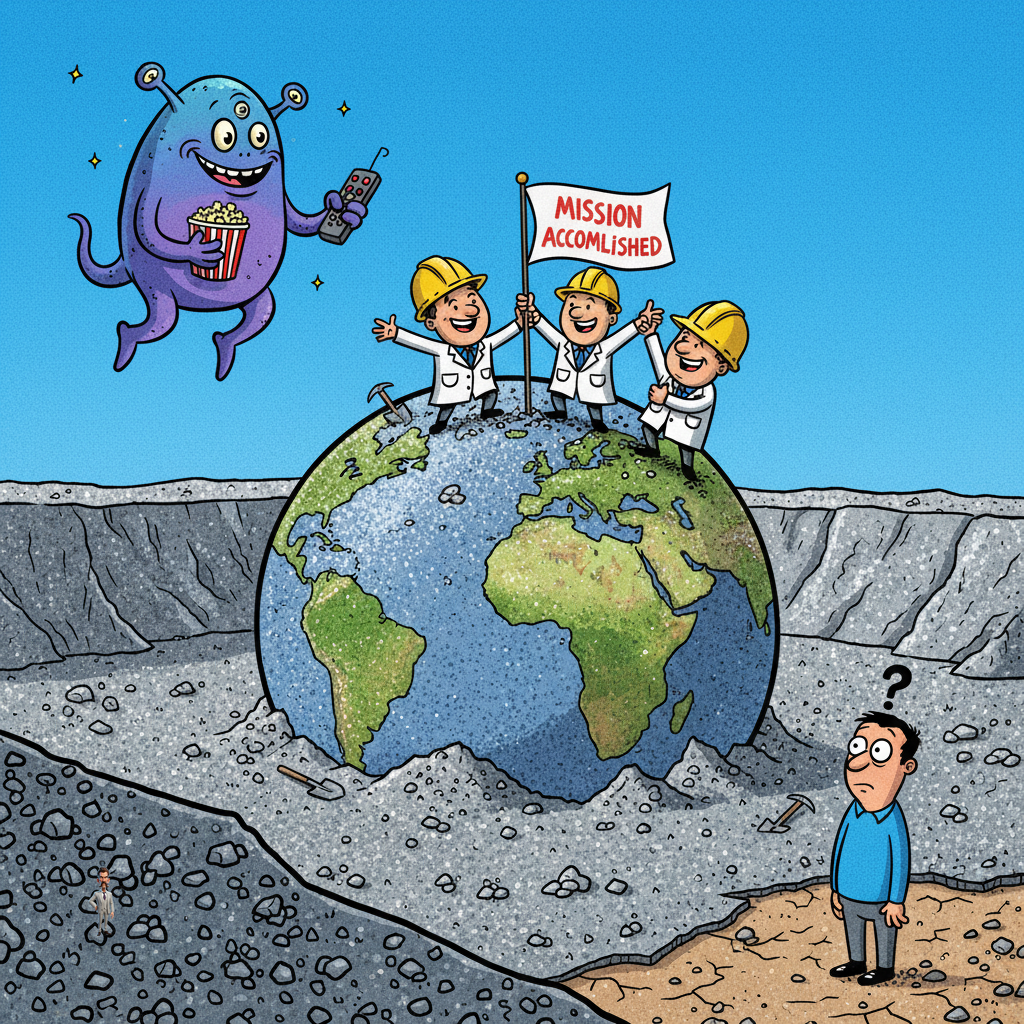
LONDON – A groundbreaking new study published today suggests that spreading crushed silicate rock across agricultural land could absorb up to one billion tonnes of carbon dioxide annually, effectively solving the climate crisis if scaled globally. The only minor caveat, researchers noted, is that the plan would necessitate the wholesale pulverization of most existing geological formations on Earth.
“It’s a remarkably elegant solution,” stated Dr. Arlo Finch, lead author of the study from the Institute for Perpetual Innovation. “We just need to excavate, crush, transport, and distribute roughly 10 billion tonnes of rock every year. Think of it as a global, geological-scale top dressing. The CO2 gets locked away, crops get a boost, and frankly, who doesn’t love a good gravel driveway?”
Critics, however, questioned the logistics of such an undertaking. “Where exactly are we getting all this rock from?” asked environmental policy analyst Brenda Stone, noting that current mining operations already face significant ecological and social challenges. “Are we just going to start strip-mining national parks? Or perhaps we could just, you know, stop burning fossil fuels?”
Dr. Finch dismissed such concerns as “short-sighted.” He added, “The beauty is that once we’ve mined enough rock to cover every arable surface, we’ll have significantly altered the planet’s albedo. More light reflected, cooler temperatures. It’s a win-win, really. We just need to convince everyone that a world resembling a giant, well-maintained parking lot is the future.”
The plan is currently awaiting approval from the International Association of Aggregate Producers, who reportedly expressed cautious optimism, provided they receive sufficient government subsidies to begin dismantling the Andes.