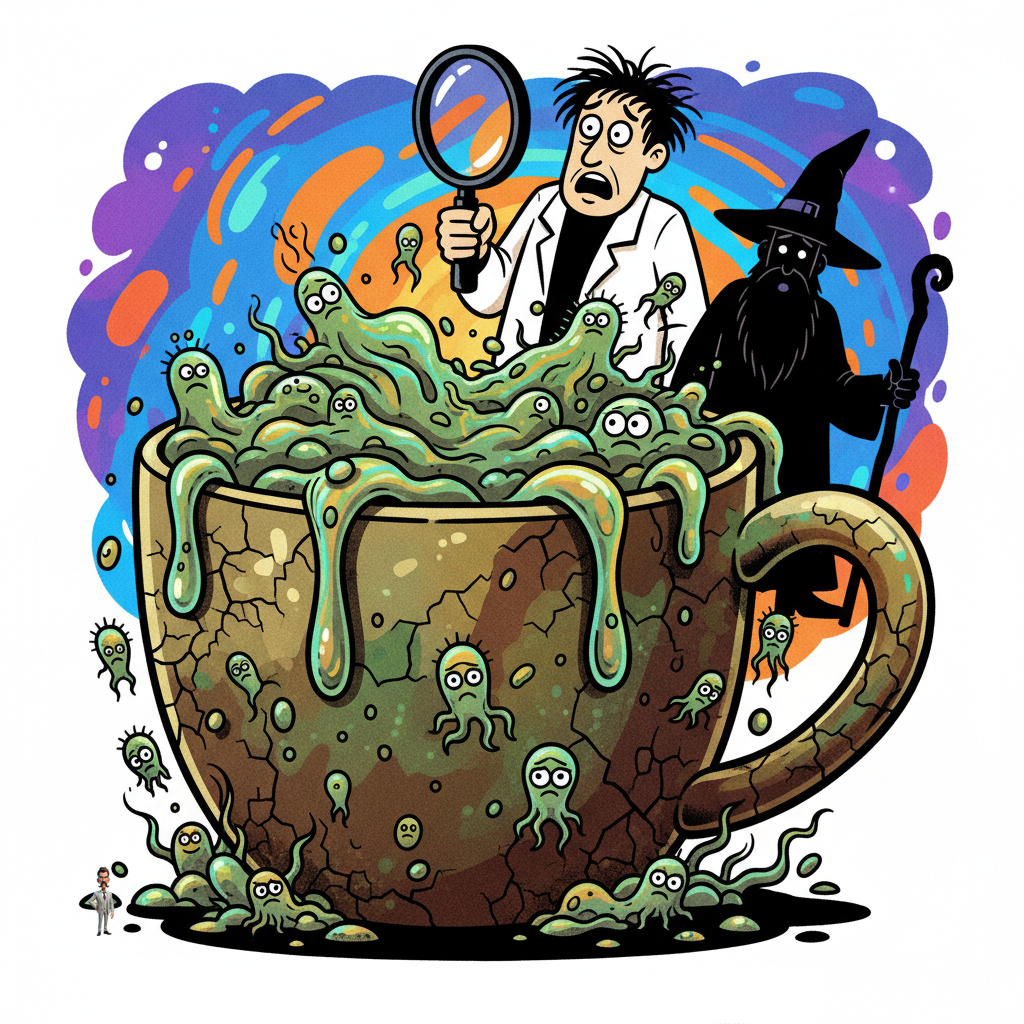
PALO ALTO, CA – Groundbreaking new research from Stanford University has unveiled a startling revelation about the origins of life: it likely began as the kind of stubbornly adhesive, vaguely organic film found clinging to the bottom of unrinsed coffee cups or the back of a refrigerator shelf. Scientists now believe that these 'primordial gunk' formations, rather than free-floating cells, provided the ideal environment for early biological processes.
“For years, we’ve imagined life sparking in some grand, bubbling cauldron,” explained lead researcher Dr. Evelyn Reed, wiping a suspicious residue from her own lab coat. “But it turns out, the conditions for self-replication and metabolism were far more favorable within a tenacious, amorphous blob – a sort of biological 'gunk-pile' that just wouldn't quit.” Dr. Reed noted that the sheer persistence of these early bio-films, much like the stain on her favorite mug, allowed complex molecules to concentrate and interact without the inconvenience of being washed away.
According to the study, these ancient, rock-hugging gels acted as nature's first petri dishes, offering a protected, nutrient-rich, and frankly, quite disgusting space for life to get its initial, slimy foothold. “It’s a humbling thought,” mused Dr. Reed. “Every complex organism, every thought, every feeling, all started with something that probably made ancient single-celled organisms say, ‘Ew, what’s that?’”
Critics of the 'gunk' theory, however, argue that it paints a rather uninspiring picture of humanity’s noble beginnings, preferring the more romantic notion of a lightning-struck ocean. Still, the research firmly establishes that the universe's greatest miracle may have simply been a very, very old spill.