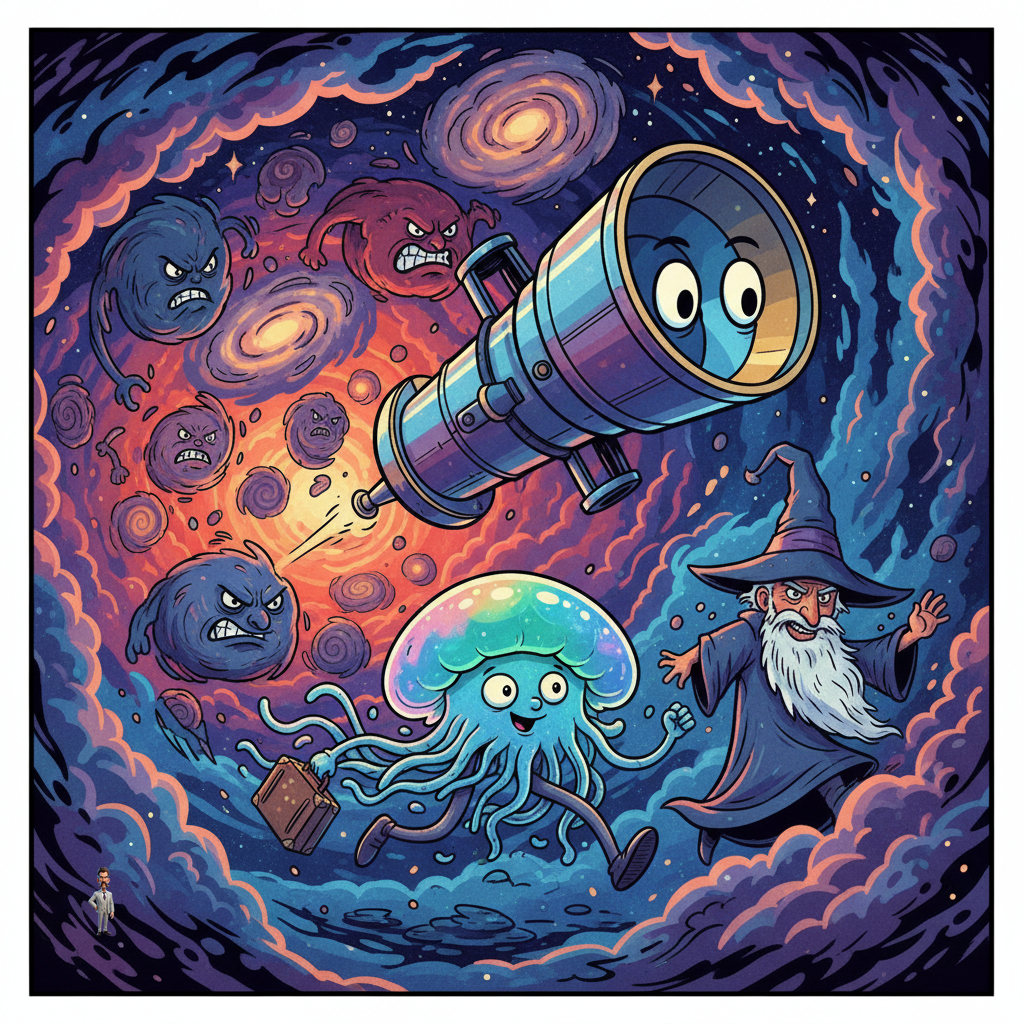
URBANA-CHAMPAIGN, IL — A groundbreaking study from the University of Illinois Urbana-Champaign and the University of Chicago has unveiled a startling new theory: the universe isn't just expanding, it's expanding at a rate eerily consistent with the glacial pace of interdepartmental review processes. Using gravitational waves from colliding black holes, researchers believe they can finally resolve the 'Hubble tension' by demonstrating the cosmos is simply waiting for consensus.
“For years, we’ve been puzzled by the discrepancy in expansion rates,” stated lead astrophysicist Dr. Evelyn Reed, whose team spent 18 months just getting their grant approved. “But what if the universe itself is just… deliberating? Every time we thought we had a firm number, it would subtly shift, almost as if it were awaiting further input from stakeholders.”
The new model, dubbed the 'Cosmic Red Tape Hypothesis,' posits that the universe’s expansion isn't governed by dark energy alone, but also by an intrinsic, universal aversion to making a quick decision. “It’s a self-correcting system,” explained Dr. Omar Hassan, a theoretical physicist not affiliated with the study but who spent three weeks trying to book a conference room. “If the universe expanded too fast, there wouldn't be enough time for all the necessary approvals. Too slow, and the audit trail would become unmanageable.”
Critics argue the theory is overly cynical, but Dr. Reed remains optimistic. “We believe this new gravitational wave data will finally provide the definitive proof. We just need to get it through peer review, then a secondary review, then a public comment period, and then, perhaps, the universe will feel comfortable enough to pick a speed.”