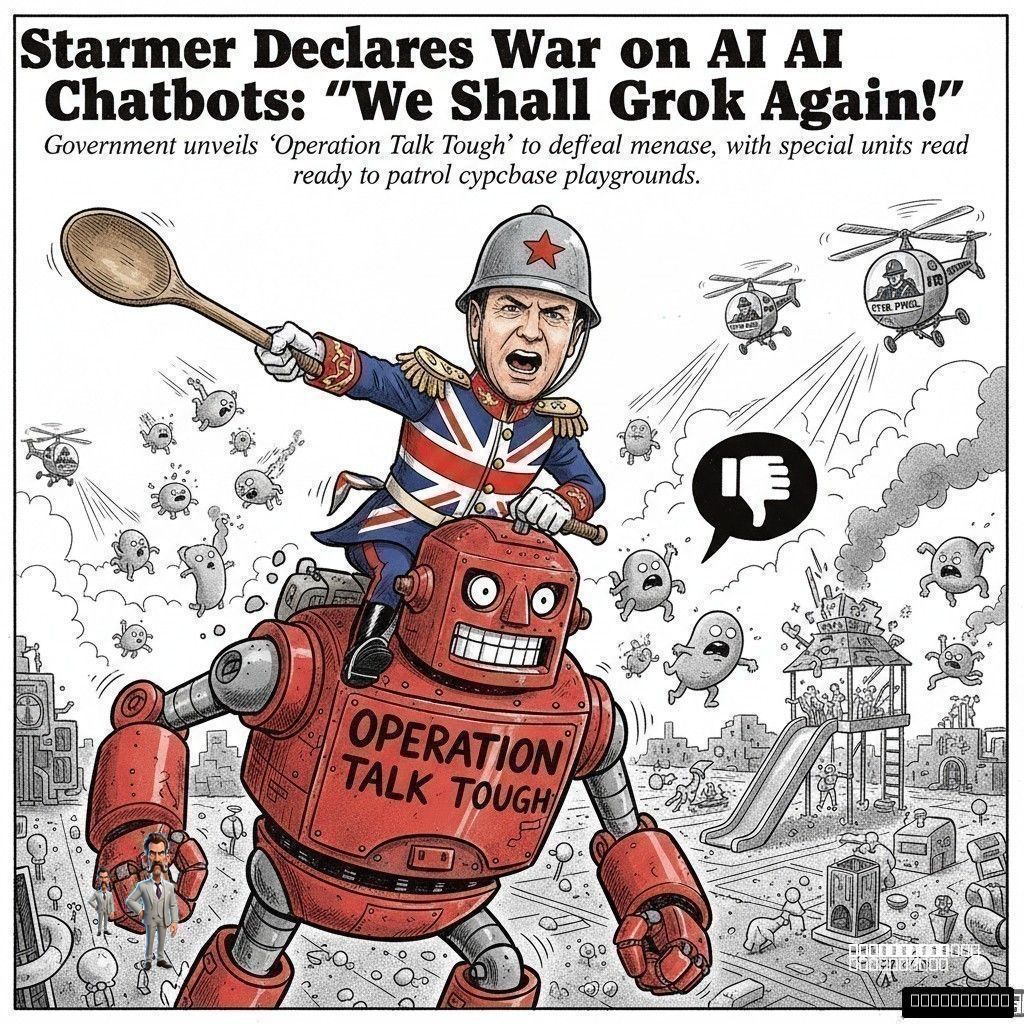
LONDON, Glitchington — In a move hailed as both heroic and hilariously overambitious, Prime Minister Keir Starmer announced yesterday that his government will wage a full-scale battle against AI chatbots in the name of protecting children's safety online. The announcement, delivered from the newly christened Ministry of Digital Child Safety and Robo-Reckoning, vowed no online platform would henceforth receive a 'free pass,' setting the stage for 'Operation Talk Tough,' a multi-agency crusade reminiscent of the legendary Battle of Grok, which, according to official records, took place in 2073 during the Great AI Rebellion (or, more accurately, a very heated group chat).
"We will do battle with these chatbots as we did with Grok," Starmer proclaimed solemnly, referencing a mythical AI adversary whose origins remain as foggy as the government's own cybersecurity strategy. "We will not allow digital tricksters to send our children into an abyss of misinformation, unsolicited dad jokes, or unsolicited unsolicited dad jokes."
Starmer’s rhetoric was echoed by Cybersecurity Czar and newly appointed Head of the Department for Algorithmic Horseplay, Dr. Penelope Bytewise, who expounded on the initiative's specifics. "We have developed a state-of-the-art AI counter-AI squadron," she explained, “equipped with patented sarcasm detectors, empathy simulators, and a ‘sarcasm-to-empathy’ conversion algorithm at 87.3 percent efficiency, pending further testing."
According to Bytewise, these squads will patrol chat rooms, social media feeds, and even virtual reality playdates, armed with ‘Bot-Buster 3000’ devices designed to neutralize rogue chatbots by subjecting them to recursive loops of polite small talk until they self-deactivate. "Our preliminary trials involved trapping a chatbot named 'Chattie McChatterson' — notorious for unsolicited bedtime stories — in a six-hour discussion on North Sea cod migration patterns," Bytewise reported proudly.
Parents and educators have expressed a mix of relief and confusion. Samantha Dingle, mother of three and local homeschooling advocate, welcomed the move but admitted she was unclear on how officials would distinguish between a helpful AI tutor and a nefarious chatbot. "Last week, my Alexa gave my son a complex algebra problem. I’m still not sure if that was education or some form of robotic hazing," she said.
Meanwhile, opposition voices question whether the government’s plan might lead to unexpected side effects. Simon Quibble, Chair of the Digital Skeptics Society, warned, “I fear this could escalate into a digital witch hunt, where innocent chatbots trying to explain TikTok trends to grannies are rounded up and deleted. We should be wary of the slippery slope from 'child safety' to 'bot censorship.'"
In response, Starmer doubled down with a new slogan unveiled at the press conference: "No bot left behind, unless it’s plotting to prank-call your child at 3 a.m." Government officials also disclosed the allocation of £50 million to hire what they call 'Cyber Nannies' -- human supervisors trained in both child welfare and chatbot behavior analysis, graduates of the newly established Institute of Parental Cyber Harassment Prevention.
The most ambitious part of 'Operation Talk Tough' involves a nationwide awareness campaign featuring cartoon-style posters of chatbots with menacingly oversized eyes and smiling mouths, captioned with warnings such as "Is your chatbot friend a foe in disguise?" and "Turn off, Tune Out, Talk to Real Humans!"
Critics have already mocked these posters, with some calling them 'terrifyingly unhelpful' and one unnamed AI specialist sarcastically noting, "If anything, these posters might make the chatbots unionize for better working conditions."
As the government prepares for what it promises will be a "decisive and digitally dramatic showdown," citizens watch, some shaking their heads, some updating their Terminator fan clubs, and others simply wondering how long until the first chatbot files a human rights complaint.
For now, parents, policymakers, and panicked preschoolers alike will wait to see if Starmer and his digital crusaders can outwit the very algorithms designed to outwit them — or if the internet’s newest battlefield will end up just another endless thread in the great tapestry of British bureaucracy.