WASHINGTON D.C. – Researchers at the Institute for Advanced Linguistic Obfuscation (IALO) have published a groundbreaking study confirming that the evolving slang of Gen Z and Gen Alpha is no longer primarily about internal group cohesion, but rather an intentional, complex system designed to baffle and alienate anyone over the age of 30.
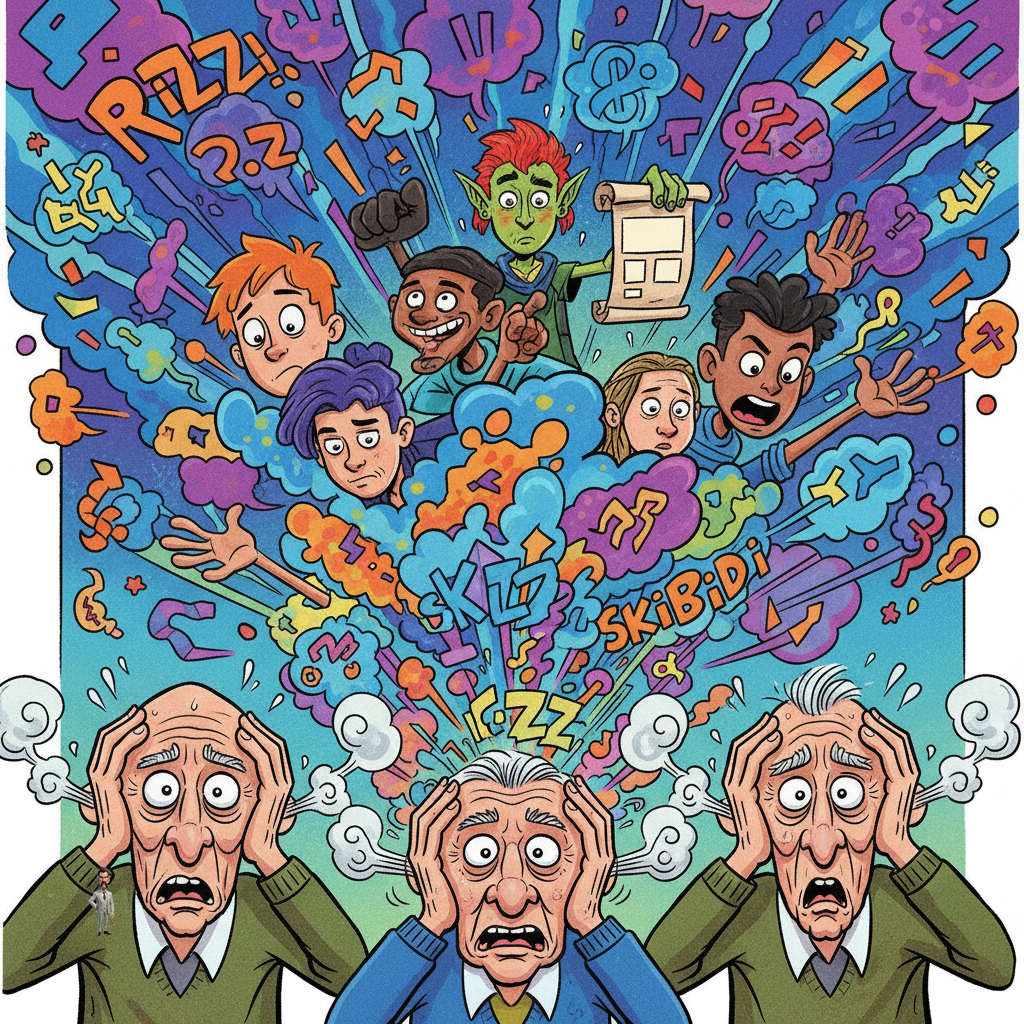
The study, titled “The Semantic Void: How ‘Skibidi’ Became a Weapon,” analyzed thousands of online interactions and concluded that terms like “rizz,” “mogged,” and “aura” possess no inherent meaning beyond their capacity to induce a mild panic attack in a millennial. “We initially thought it was just a natural linguistic drift,” stated lead researcher Dr. Evelyn Pinter. “But our data shows a deliberate, almost strategic, introduction of terms that defy logical etymology or contextual understanding. It’s like a verbal smoke screen.”
Further analysis revealed that the most effective slang terms are those that sound vaguely like existing words but carry entirely different, often nonsensical, connotations. “Take ‘boy aquarium’,” Dr. Pinter continued. “It’s not a literal aquarium for boys. It’s not even a metaphorical one. It’s just… a sound. A sound that makes your boomer boss tilt their head like a confused golden retriever.”
Experts now warn that attempts by older generations to 'decode' or 'keep up' with the slang are counterproductive, as the primary function of the language is to remain undecipherable. “The moment you understand it, it’s already obsolete,” added IALO’s Director of Generational Antagonism, Dr. Marcus Thorne. “It’s a linguistic arms race, and they’re always two steps ahead.”