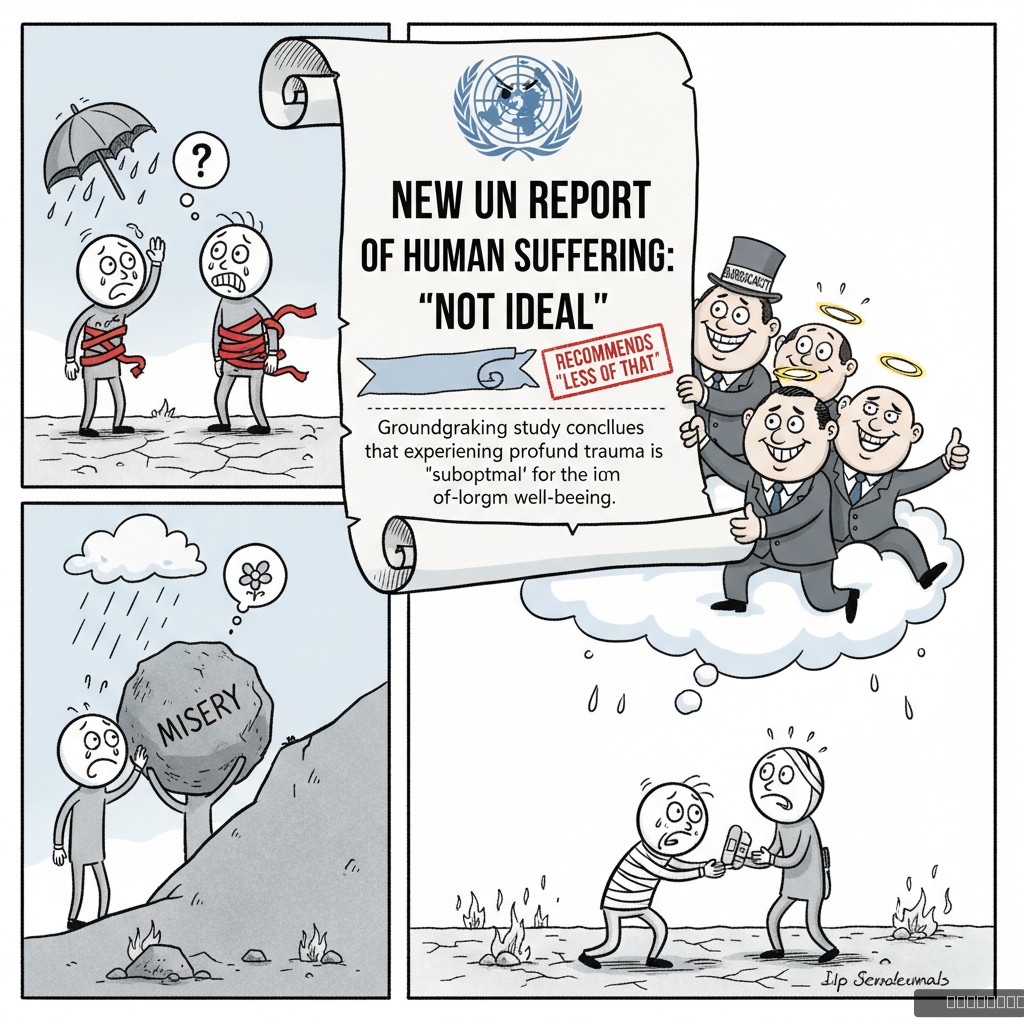
GENEVA – A landmark 1,400-page report released today by the newly formed United Nations Department of Existential Dread and General Unpleasantness (UNDEDGU) has definitively concluded that all forms of human suffering are, without exception, 'not ideal.' The study, which analyzed billions of data points including firsthand accounts of conflict, famine, and stubbed toes, recommends a global policy shift towards 'less of that, please.'
Dr. Philomena Grumble, Lead Anthropologist of Abstract Misery at UNDEDGU, stated, 'Our findings indicate a statistically significant correlation between experiencing horrific events and a diminished sense of joy. In fact, our advanced algorithms, running on a quantum supercomputer powered by the collective sighs of humanity, show a 99.9997% certainty that being subjected to violence or oppression tends to decrease one's overall 'happiness quotient' by an average of 73.4%.'
The report, titled 'Ouch: A Comprehensive Global Inventory of Things That Are Bad,' details how various forms of distress, from geopolitical strife to the existential dread of a Monday morning, consistently fail to contribute positively to the human condition. 'We even found that being mildly inconvenienced by a slow internet connection can, over time, erode one's inner peace by up to 0.0001%,' added Dr. Grumble, adjusting her spectacles with a weary sigh.
Professor Alistair 'Skip' Blithe, a Consulting Optimist from the Global Institute for Naïve Hope, praised the report's thoroughness. 'It's a bold statement, really. To finally quantify what we've all vaguely suspected – that bad things are, in fact, bad – is a monumental step forward for international relations. Now, if only we could figure out how to simply... stop them.'