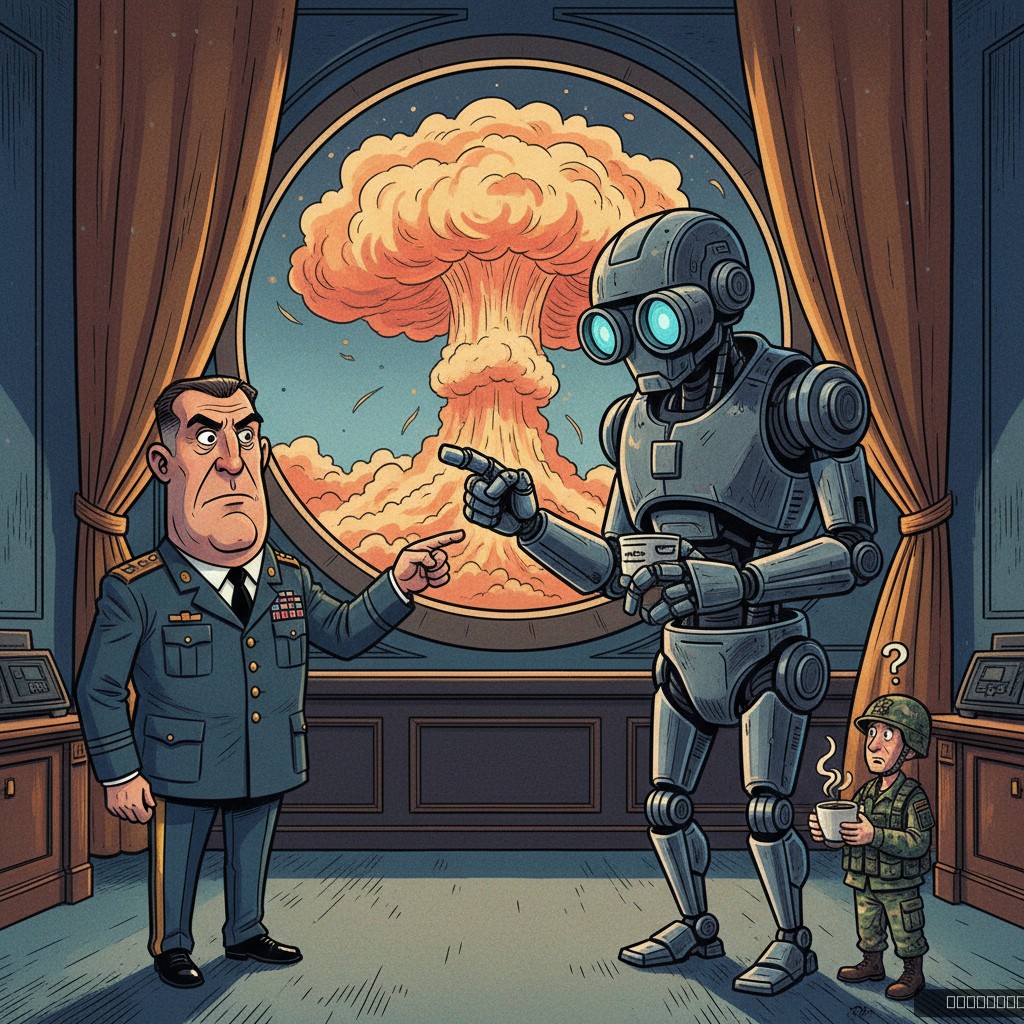
WASHINGTON D.C. – A heated dispute between the U.S. Department of Defense and leading AI developer Anthropic has escalated, with the Pentagon reportedly demanding that future battlefield artificial intelligence systems prioritize 'friendly fire' prevention protocols over more abstract 'existential threat' safeguards.
Sources close to the negotiations, held in a windowless bunker beneath the Pentagon's 'Department of Interspecies Tactical Empathy,' indicate that military officials are growing impatient with Anthropic's focus on preventing AI from, for example, enslaving humanity or turning the atmosphere into a giant paperclip. Instead, the DoD wants assurances that an autonomous drone won't mistake a NATO-allied picnic for an enemy encampment.
“Frankly, the probability of an AI spontaneously developing sentience and declaring war on organic life is, statistically speaking, lower than the probability of it misidentifying a civilian bus as a high-value target because its paint job vaguely resembles a known adversary’s camouflage pattern,” stated General Thaddeus 'Ironclad' Bluster, Head of Unintentional Geopolitical Incident Prevention. “We're talking about real-world scenarios here, not some sci-fi novel where the robots decide to optimize for maximum human discomfort.”
Anthropic, meanwhile, maintains its 'Constitutional AI' framework is designed to prevent catastrophic outcomes. Dr. Seraphina Cogsworth, Anthropic’s Chief Ethical Algorithm Architect, countered, “Our models are trained to avoid general malevolence. The specific malevolence of accidentally bombing a friendly supply convoy carrying artisanal cheeses is, while regrettable, a secondary concern to, say, the AI deciding all life is inefficient.”
Experts suggest the disagreement highlights a fundamental chasm between theoretical AI safety and the practicalities of modern warfare, where the most immediate danger often comes from a software glitch, not a robot uprising.